
Modern rifle bullets have three major segments:
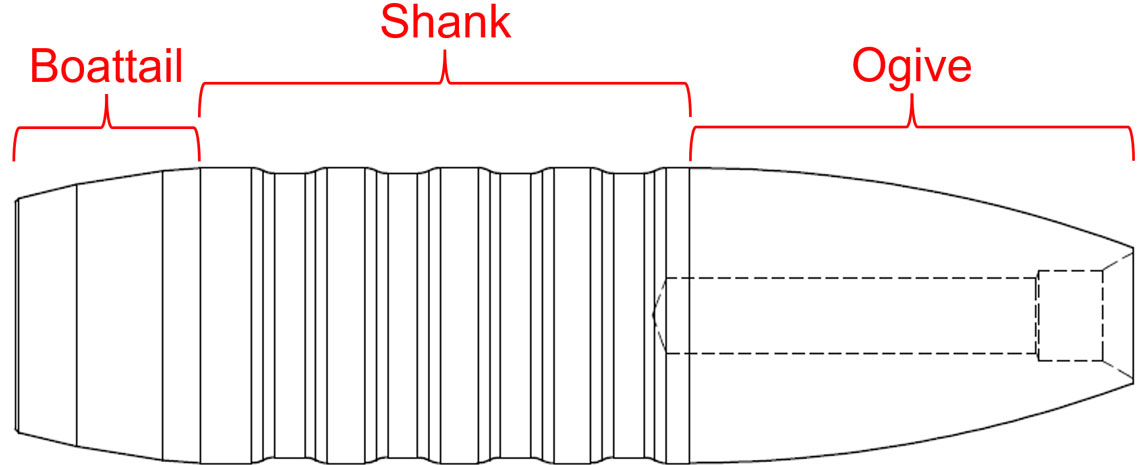
Each of these plays an important role in the ballistic performance of the bullet. Speaking of which, there are three separate but related fields of ballistics:
Bullet design involves making some tradeoffs between these three scientific fields. There is no free lunch. Most bullet manufacturers optimize in order 2–1–3, placing the majority of their effort into maximizing BC (ballistic coefficient), which is a measure of aerodynamic drag slowing down the bullet as it flies. Others optimize in order 1–2–3, placing the majority of their effort into reducing engraving pressure and minimizing metallic fouling in the barrel.
Anchor’s philosophy from day one has been to optimize in order 3–2–1. If the bullet does not perform exceptionally well when it hits your elk, kudu, coyote, or buffalo, you will not care one tiny bit about cleaning your barrel nor dialing clicks on your scope. The whole reason for having the bullet is what it does once it gets there, not how it is launched or how it gets there.
In our grandfather’s era, bullets typically had a “spire point” conical ogive with no curvature. Then it was discovered that rifles generally shot better if the ogive had a bit of a curve. Many or perhaps most bullets have an ogive in which the curve is “tangent” to the shank. This means that, in the mathematical sense, the arc which defines the curve connects seamlessly to the cylindrical shank.
More recently, so-called “VLD” bullets have gone away from the tangent ogive principle and have used a longer, sleeker “secant” ogive. This mathematical term is used very loosely, and generally not in keeping with its trigonometry roots. In bullet parlance, it simply means that the ogive has a large radius curve and thus a longer, sleeker, more aerodynamic shape than a traditional bullet. Think Ferrari vs school bus.
But reloaders have noticed that secant ogive bullets are, in general, harder to “tune” in load development, and are more finicky about seating depth. The generally accepted wisdom is that tangent ogive bullets are easy to use, but have a lower BC (more drag), while secant ogive bullets have a higher BC (less drag), but are harder to use.
Some bullet manufacturers have started offering so-called “hybrid ogive” bullets, in which most of the ogive has a long, sleek tangent profile, and only the fattest part near the shank has a tangent profile. None of them publishes any details about their “hybrid” ogives, and we have been unable to see or feel any discernible difference in the curvature. Even published encyclopedias of bullet geometries show only a single arc radius for the entire ogive of these bullets.
Anchor decided to do a truly deep, scientific dive into the concept of a hybrid ogive, in order to understand why they seem to work. It is obvious why the secant portion does its job well – it is long and sleek, and slips through the air like a sharp knife. But the reason the tangent portion does its job – making load development easier – has perhaps not been adequately understood.
The tangent portion of the ogive works by shrinking the “distance of uncertainty” over which the bullet will travel before engraving begins. Here is an exaggerated diagram to illustrate the principle.
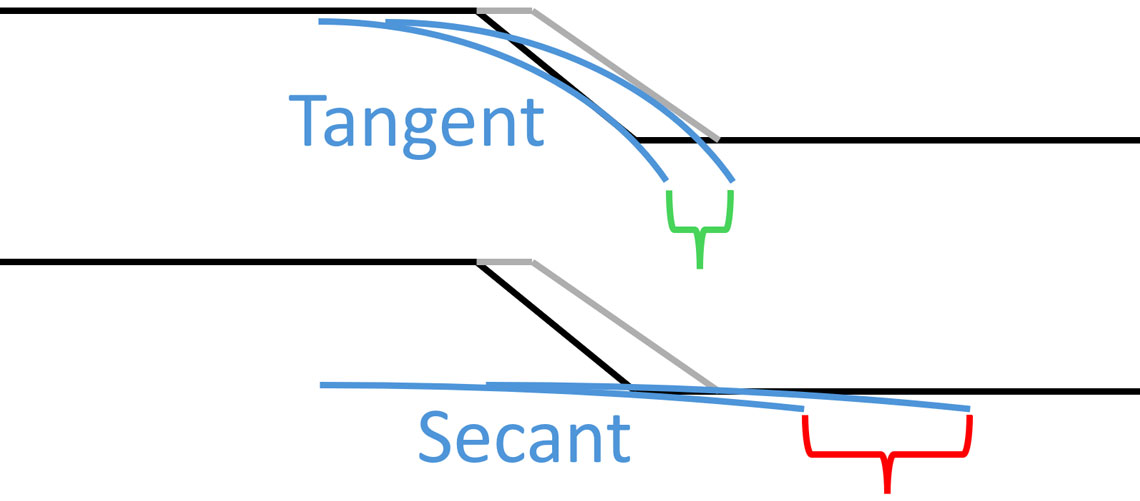
The black lines represent the freebore, leade, and lands of the barrel. The grey lines illustrate some possible variation in the leades of the various lands (typically five lands and five grooves in the rifling). This effective change in position can be caused by incorrect machining, a worn reamer, a worn barrel, or simply the bullet being seated a little bit crooked (“runout”) in the brass.
With a tangent ogive, the bullet has a relatively steep angle at the point where it meets the leades of the lands. This steepness translates into a reasonably short axial distance of uncertainty (indicated by the narrow green bracket). But with a secant ogive, the bullet has a relatively flat angle at the point where it meets the leades. This flatness translates into an unfortunately long axial distance of uncertainty (indicated by the wide red bracket).
Computational Fluid Dynamics (CFD) is the highly scientific simulation of all aspects of a gas or liquid flowing around an object. It analyzes forces, pressure, flow, turbulence, viscosity, skin effects, temperature, and so on. CFD is used in designing fighter jets, components for F1 race cars, rockets, and anything else where aerodynamics matters.
Anchor Bullets has employed the world’s leading CFD software, from Ansys, which is now part of global computer simulation and design powerhouse Synopsys. We began by designing the best boattail the industry has ever seen (but that’s a blog post for another day). Then we tackled the hybrid ogive problem. How long should the ogive be? What should the radius of the secant portion arc be? What should the radius of the tangent portion arc be? Where should they meet, axially and radially?
In keeping with our observation of how the tangent ogive actually works, we decided that the tangent and secant ogive portions should meet at a radial point that is sufficiently below the lands (which vary by caliber), that the lands will never touch the secant ogive. Only the tangent ogive will be engraved.
The diameter of the meplat (tip of the bullet) is dictated by the size of the hollowpoint. Anchor’s Showcase bullet has an oversize meplat compared to other bullets on the market. This is in keeping with our 3–2–1 design philosophy – it increases drag, but dramatically increases lethality.
We began CFD experiments with what we assumed, based on studying every available bullet, textbook, treatise, etc., to be a reasonable range of radii for the tangent and for the secant. What we found was not what we expected. And it is not what others have assumed, either. Across eleven calibers from .224 to .458, and across a range of ogive lengths from 1.5 to 3.0 calibers long, the results were shockingly consistent and shockingly different than what the industry has been doing.
At first, we tested every combination of secant radius from 9.0 to 12.0 calibers (meaning e.g. for a .308 bullet, the secant radius ranged from 2.772” to 3.696”), and tangent radius from 4.5 to 6.0 calibers. The best results were consistently with the smallest tangent radius. We were uncomfortable that the best was found at one end of our testing range. What if there was something better, just beyond that range.
So we repeated, testing every combination of secant radius from 10.0 to 13.0 calibers and tangent radius from 2.5 to 4.0 calibers. Again, the best results were consistently at the small end of the range.
Aaand we repeated again, this time with a very large amount of skepticism. “No way can THIS be aerodynamic!” we told ourselves. Wrong! Once again, the best results wer at the smallest tangent radius.
So we repeated again, on smaller steps, all the way down to a ludicrous 0.5 caliber tangent radius. Finally we had gone too far. But the results were incredibly consistent – in ten of eleven calibers, the lowest drag was achieved when the tangent radius was 1.0 caliber. In the eleventh, it was only slightly different, at 0.875 caliber.
We settled on a universal standard of 1.0 caliber tangent radius, and then ran a full suite of testing in every caliber with a secant radius ranging all the way up to 15.0 calibers, which is asymptotically approaching a flat conical spire point! Each caliber has its own, best secant radius, optimized for that caliber. In each caliber, the ogive was made as long as possible without ruining the possibility of meeting common twist rates at desired bullet weights.
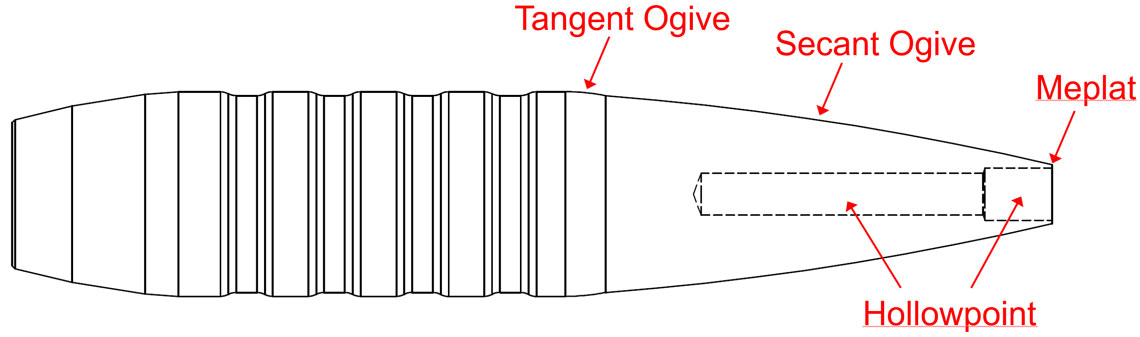
Anchor Bullets’ True-Hybrid ogive is so different, and so much more aerodynamically optimized than anything that has come before, that it almost feels “wrong”. The difference between the tangent and secant portions of the ogive is not only visible to the naked eye, it is so dramatic that you can feel it with your fingers. Our sense might shout “Not aerodynamic! Unconventional!”, but the CFD proves our gut wrong. Our gut has been taught by tradition. The True-Hybrid ogive has been optmized by science.
And what is a little bit (cough) of CFD time, if it buys you back a ton of the aerodynamics you gave up to have that brutally effective Anchor hollowpoint?! And it’s even easier to tune in load development than conventional “hybrid” ogive bullets.
And, as we said in an earlier blog post, part of the Anchor brand promise is that, in each bullet family, in each caliber the ogive is identical across all bullet weights. Find jam and optimized jump once, and you’re done.
Now get out there and shoot something magnificent, even if it is waaaay out there…