
Modern rifle bullets come in two flavors:
Most manufacturers produce the former, with a lead core surrounded by a jacket of C21000 “gilding metal”, which is an alloy of 95% copper and 5% zinc. The zinc allows the jacket to be “drawn” from a cup-shaped starting piece, and improves corrosion resistance.
Copper monos are, as the name indicates, formed as a monolithic piece of some type of copper. It may be pure copper, or it may be a different alloy for machinability purposes. Some copper monos are impact extruded, swaged, or machined.
Both types of construction work very well in both hunting and target competition. But there are some important differences, which the reloader and shooter must consider.
Lead is softer than copper, but it is more dense, meaning it is heavier for the same volume or size. Jacketed lead core bullets are what most shooters are used to using, but they have some drawbacks.
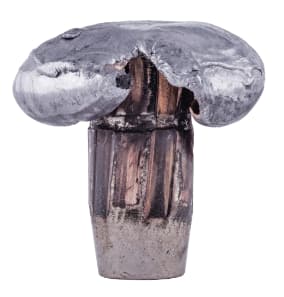
At the top of that list is often poor weight retention. When a jacketed lead core bullet hits an animal, it mushrooms and loses weight as it plows through the animal’s tissues. The weight is lost as the lead melts due to friction, largely accomplishing no positive result after leaving the bullet. And lead is toxic if eaten. The more weight is lost, the more the bullet loses its momentum, and the less penetration there is through the animal. This continues until the bullet has slowed down enough that the friction is no longer melting the lead.
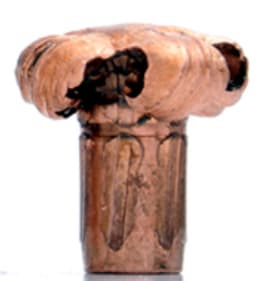
Some copper monos are engineered to mushroom and have nearly 100% weight retention. The goal of that design is to achieve the mushrooming of a jacketed lead core bullet, without the lead trail and without the reduced penetration. With all mass staying on the bullet, momentum is lost only to friction and tissue resistance. These copper monos typically have a much higher chance of producing a meaningful exit wound, which improves blood loss and ease of tracking.
Anchor Bullets copper monos are engineered to kill in a different fashion. That is a detail to be discussed in a later post. It’s awesome.
We mentioned that copper is less dense than lead. What this means, in practical terms, is that at the same caliber and weight, a copper mono will be slightly longer than a similar jacketed lead core bullet. With all bullets, but especially with copper monos, the shooter must very consciously consider the twist rate of the rifle’s barrel. If the twist rate is too slow, the bullet will not be adequately stabilized, and will tumble in flight.
Twist rate is marked on most barrels, typically in the form “1:8” or “1 in 10” or the the like. The first number means that the rifling and thus the bullet make “1 full revolution” around the bore axis in the number of inches (specified by the second number) that it travels down the barrel. A 1:12 barrel is slower than a 1:10 barrel. A bullet which is fully stabilized by that 1:10 bullet may well NOT be stablized if shot through the 1:12 barrel. Remember: the smaller the second number, the FASTER the twist rate. Twist rate is your friend. Most modern rifle makers have done a great job increasing the twist rates in their barrels, allowing shooters to take advantage of modern bullets such as high-BC hunting and target bullets with longer ogives and often greater weights. When buying a new rifle, if you have a choice between e.g. a 1:10 barrel and a 1:8 barrel, it is almost always the smarter choice to choose the faster twist. The only reasonable exception is if the hunter wants to push extremely thin-jacketed varmint bullets at such extreme velocities that the jacket will blow apart in flight simply due to the crazy spin rate (often over 325,000rpm) of the bullet. Note that copper monos do not have this problem at all!
Many bullet manufacturers provide recommended twist rates with their bullets. But the shooter must be aware that the stability (Sg) of a bullet is determined by many factors, of which twist rate is just one. Others include bullet weight, bullet length, velocity, and air conditions such as atmospheric pressure, altitude, temperature, and even humidity. Of these, velocity is the most important. A bullet which is fully stabilized when fired at 3,200fps from a 6.5 PRC rifle may very well be very unstable if fired at 2,700fps from a soft-loaded 6.5 Creedmoor rifle.
When in doubt, use one of the online tools to calculate the stability of your bullet in your rifle at your conditions. We like these:
Note: you should input the total length of your bullet. If it has a polymer “tip”, do not specify that separately, just input the full length including the tip.
There is an important fact which shooters and reloaders must consciously consider – copper and gilding metal are not the same. If you have been shooting jacketed lead core bullets, it is common to observe “copper fouling” in the barrel. It is important to recognize that this is gilding metal fouling, NOT copper fouling. Even the common cleaning products are labeled for removing copper fouling. Most will remove both gilding metal and copper, but not completely.
When switching between jacketed lead core and copper monos, it is vitally important to clean the barrel DOWN TO BARE METAL. If you do not, the second type of bullet, which is being shot over the first one’s fouling, WILL NOT GROUP on target. Many shooters have rejected copper monos on the mistaken first impression that copper monos “don’t group well”, when the actual fact is that gilding metal and copper do not like each other. If you have gilding metal fouling, you must remove ALL of it before shooting copper monos. And if you have copper fouling, you must remove ALL of it before shooting jacketed lead core bullets.
Normal “cleaning” products will not achieve this, no matter how many patches you use. Anchor Bullets highly recommends ThorroClean or J-B products. In addition to cleaning chemically, like your favorite CLP etc, they clean mechanically, with micro abrasives. And, no, they do NOT hurt your barrell’s rifling in the least. Wrap a cotton patch around a one-size-small nylon brush, slather it in the paste, and make 25 full passes through the barrel. That’s usually all it takes. A very dirty barrel might want a second patch’s worth. When that is done, rinse the barrel with ThorroFlush or your favorite CLP using as many patches as necessary (usually two or three). Finally, leave a nice layer of your favorite gun oil or CLP in the barrel, to prevent rust and to lubricate that first fouling shot. Anchor Bullets’ favorite is Radcolube. Our favorite general-purpose cleaner for removing carbon etc is BoreTech Eliminator.