
When developing a custom “hand load” for a rifle, the most important pieces of the puzzle are:
Let’s talk about those first two things – the biggies.
First, the bullet must be well suited for the intended usage. Don’t hunt with target bullets. And don’t ask a varmint bullet to take down a buffalo.
Anchor currently offers four families of bullets, each optimized for a specific usage:
Whether you choose to measure COL/COAL (cartridge overall length) using calipers, or base-to-shoulder-datum using calipers and a set of headspace gauges, the goal is to make each round identical. And whether you seat your bullets with a conventional press die, or a competition press die with a micrometer head, or an arbor press seating die with a micrometer head, the goal is to make each round identical.
There are two key aspects to a “best” seating depth. First, the round must fit and feed reliably in your rifle’s magazine, whether it is a removable magazine or an internal box magazine. Second, the seating depth must be “tuned” to some specific amount of “jump” which your barrel prefers for that bullet.
Jump is simply how much shorter your round is loaded, versus the longest it could be and have the bullet juuuust touch the leade of the rifling lands. A later blog post will discuss how to find jam. In the meantime, search Youtube. These are good examples:
Anchor bullets, like many other copper monos, are less sensitive to the ultra-fine details than are jacketed lead core bullets. When finding a good seating depth with Anchor bullets, you can move the bullet in increments of 0.010” (aka “ten thou”) or even 0.015”. With jacketed lead core bullets, it is generally wise to move in increments of 0.005” or perhaps 0.003”. And copper monos often prefer a lot more jump than do jacketed lead core bullets. With Anchor bullets, try starting 0.030” from jam.
Here is an example from a recent seating depth ladder we shot:
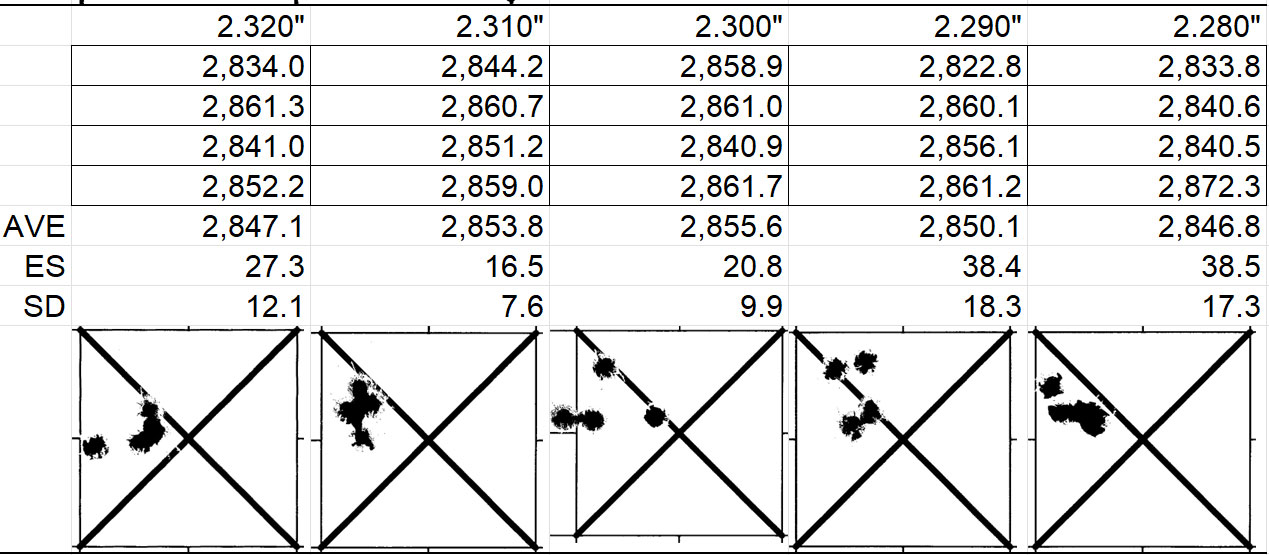
Four shots is a very small data sample, and certainly five groups of five at each seating depth would be much more statistically significant, but most of us don’t have that much time nor that many components on hand, so we do the best we can. (But please shoot at least four, and preferably five shots in each group. Three simply isn’t enough, in our experience.)
We do our seating with LE Wilson micrometer dies and a nice arbor press. And we prefer to start long and work shorter from there. In this rifle, jam was at 2.350” (base to shoulder datum), and we started with our customary 30 thou jump as the longest ladder step / least amount of jump, at 2.320”. And as you can see, our ladder was on 0.010” steps. It’s a great sign that, as seating depth changed, the groups didn’t really move much around the target.
This barrel seems to like that 2.310” depth the best, and produced a very nice group with a good SD and a somewhat acceptable ES. It will not always be the case that the best group and the best SD are at the same seating depth. When that happens, look at the big picture and try to figure out what story your barrel is telling you.
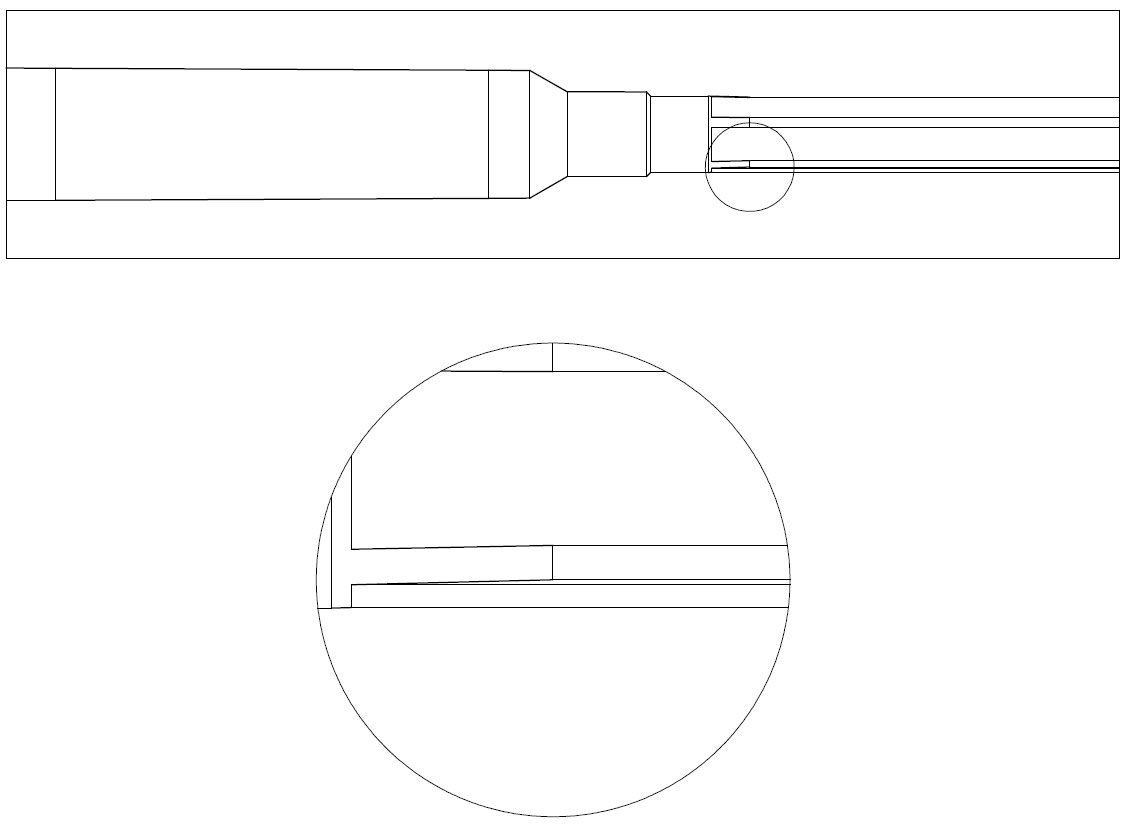
Jump is the distance the bullet travels forward before it begins to be engraved by the rifling. A barrel’s rifling is a set of “lands and grooves” that twist in a spiral from the chamber end to the muzzle end of the barrel. The near end of the lands is called the “leade”, and it is where engraving begins.
In this illustration, you can see the lead, which is the shallow “ramp” that goes from the full-caliber freebore to the top of the land. This is what first contacts the ogive (rounded nose) of the bullet.
Anchor Bullets was founded by hunters who reload – a lot. One of the things we found difficult with other manufacturers’ bullets was the lack of consistency in the shape and dimensions of their ogives. If we developed a load with a 165gn Deerhitter, and then we wanted to try the 180gn Deerhitter, we had to repeat the entire process of finding jam, setting up our seating die, and shooting a seating depth ladder.
Anchor Bullets solves that problem for you. In each respective caliber in any given Anchor bullet family, the ogive is identical. Literally identical. (As is the boattail, by the way.) Once you have found jam for any .308 Reaper-X bullet, you have found jam for ALL .308 Reaper-X bullets. Once you have found jam for any .264 Showcase bullet, you have found jam for ALL .264 Showcase bullets. And so on.
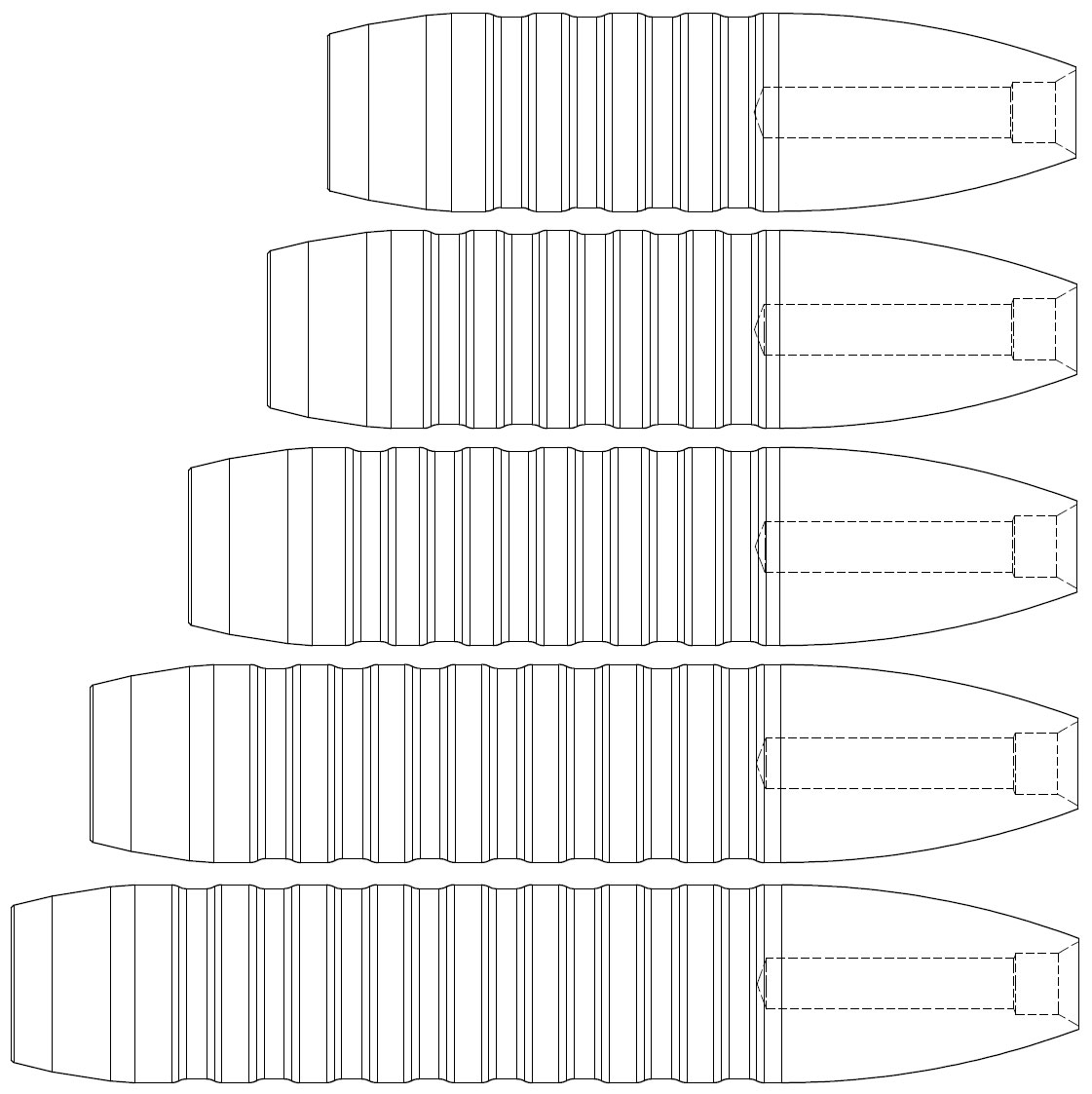
Within a caliber in a family, the only thing that changes between the various bullet weights is the length of the shank between the ogive and the boattail, with a corresponding change in the number of grooves (which are there to reduce engraving pressure and improve velocity).
Here is one example – the .308 Reaper-X family of bullets in 155gn, 170gn, 190gn, 215gn, and 235gn weights. Same ogive. Same boattail. Same hollowpoint. Only the shank differs.
It might seem like a little thing. But we want to make the reloader’s life as easy as possible, and make his or her ammo as consistent as possible with the least amount of effort.
More time finding jam = more time hunting or at the range!